Generic Webhook — Engineering
Developers building or maintaining the Delivery Service and Configuration API.
System architecture
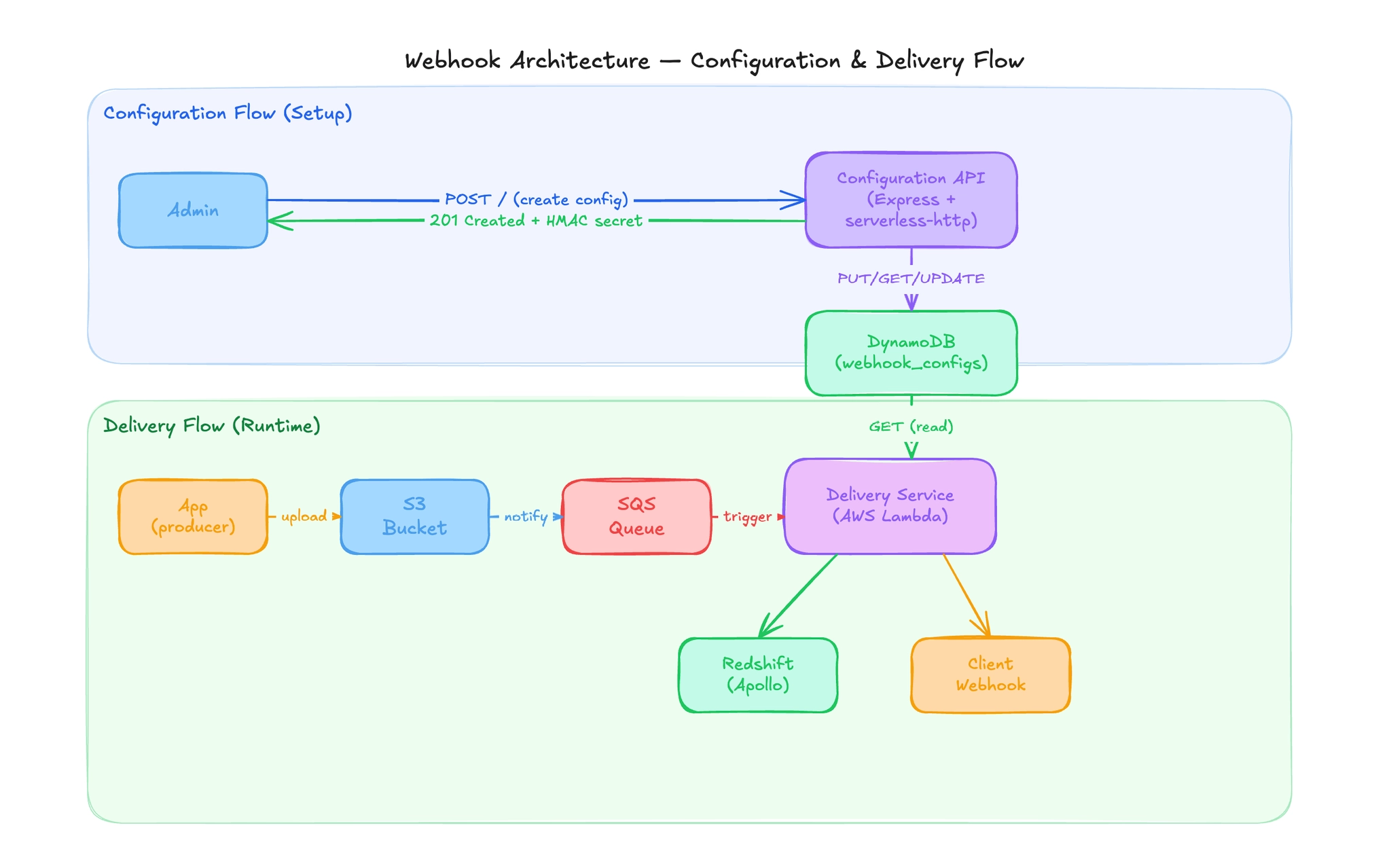
Two separate services share one DynamoDB table:
Configuration API (ind/generic-webhook)
- Express.js app wrapped in
serverless-httpfor Lambda deployment - CRUD endpoints for webhook configs stored in DynamoDB
- JWT (RS256) or appId/appKey authentication with IP whitelisting
Delivery Service (global/generic-webhook)
- Raw AWS Lambda triggered by SQS
- Bucket-agnostic — reads from the S3 bucket S3 notifies via SQS
- Reads configs from DynamoDB, signs payloads, delivers to client URLs
- Logs delivery metrics to Redshift via Apollo service
Codebase structure
Delivery Service (global/generic-webhook)
├── index.js           # Lambda handler + all core business logic
├── utils.js           # Redshift log payload builders
├── package.json       # aws-sdk, axios, fast-json-stable-stringify, lodash
├── .gitlab-ci.yml     # CI/CD - deploys to ap-south-1, REPLICATE=TRUE
├── test-bugs.js       # Bug regression tests (run with: node test-bugs.js)
└── database/
    ├── knexfile.js    # Redshift connection config (client: "redshift", port: 5439)
    ├── package.json
    └── migrations/
        ├── 20240131070646_addGenericWebhookTable.js
        ├── 20241204022244_addProcessingTimeFields.js
        └── 20241204022715_addGenericWebhookFailureTable.js
Configuration API (ind/generic-webhook)
├── index.js                  # Express app entry point + route definitions
├── controller.js             # Route handlers (storeConfig, getConfigs, updateConfig)
├── middlewares.js            # IP whitelist + auth middleware
├── utils.js                  # generateSecret, getPartiallyMaskedString
├── package.json              # express, serverless-http, joi, aws-sdk, kubera-logger
├── .gitlab-ci.yml            # CI/CD - PROJECT=generic-webhook-api
└── utils/
    ├── dynamoDb.js           # storeData, getData, updateData
    └── inputValidator.js     # Joi schemas + validate middleware
Delivery Service
Batch Processing
- AWS Lambda entry point for SQS events
- Processes messages in parallel
- Supports partial batch failure handling using SQS retry mechanisms
Per-Message Flow
For each incoming message:
- Extracts S3 bucket and file key from the message
- Fetches webhook payload (
webhook.json) from S3 - Retrieves configuration from DynamoDB using identifiers
- Skips processing if the configuration is inactive
- Optionally removes identifiers from payload based on config flags
- Generates an HMAC signature if a secret is configured
- Determines target webhook URLs using routing/workflow logic
- Sends the webhook request
Webhook Delivery
- Sends requests to multiple URLs in parallel
- Uses isolated HTTP clients per configuration (for SSL customization)
- Logs delivery lifecycle events:
- Before sending (pre-delivery)
- After success (post-delivery)
- On failure (error logging)
- Failures may trigger retries unless explicitly ignored for certain cases
Configuration Fetching
- Retrieves configuration using a composite key
- Returns full configuration or null if not found
HMAC Signature Generation
- Uses deterministic JSON serialization (sorted keys)
- Signature format:
transactionId + "_" + serializedPayload - Uses SHA256 and returns a hex digest
Logging / Telemetry
- Sends delivery logs to a telemetry service (for Redshift ingestion)
- Includes timing and delay metrics
- Logging is non-blocking and does not interrupt delivery flow
Utility Logic (Delivery Side)
Logging Payload Builder
- Constructs structured logs for:
- Pre-delivery (processing timestamps and delays)
- Post-delivery (delivery timestamps and delays)
Error Logging
- Extracts HTTP status and error message from failed requests
- Formats structured failure logs
Array Validation
- Utility to check if a value is a non-empty array
- Used for validating workflow routing inputs
Configuration API
Create Configuration
- Stores webhook configuration in DynamoDB
- Can generate a secret if requested
- Logs masked versions of sensitive fields
Fetch Configuration
- Retrieves configuration from DynamoDB
- Secret is excluded unless explicitly requested
Update Configuration
- Dynamically updates only provided fields
- Primary keys remain immutable
- Supports secret rotation
Middleware
IP Whitelisting
- Restricts access based on allowed IPs
- Supports wildcard configuration
- Rejects requests if validation fails
Authentication
Supports two methods:
- JWT-based
- Verifies token using a public certificate
- Extracts identifier from token
- Credential-based
- Validates identifier + key via external service
- Uses in-memory caching (15-minute TTL)
Input Validation
- Uses schema-based validation for incoming requests
- Rejects invalid input with appropriate error responses
Supported Inputs
- Required identifiers and configuration fields
- Optional flags for:
- Headers
- Secret updates
- Workflow routing
- Payload modification
DynamoDB Operations
Database schemas
Redshift - generic_webhook (success logging)
One row per successful delivery.
CREATE TABLE generic_webhook (
  id BIGINT IDENTITY(1,1) PRIMARY KEY,
  app_id VARCHAR(40),
  transaction_id VARCHAR(256),
  event_id VARCHAR(256),
  event_type VARCHAR(256),
  hv_event_name VARCHAR(100),
  env VARCHAR(40),
  additional_properties VARCHAR(65535),
  webhook_delivary_delay INTEGER,         -- ⚠️ typo in column name - do not rename
  event_start_timestamp TIMESTAMP,
  webhook_delivery_timestamp TIMESTAMP,
  original_timestamp TIMESTAMP,
  webhook_processing_timestamp TIMESTAMP,
  webhook_processing_delay INTEGER
);
Redshift - generic_webhook_failure (failure logging)
One row per failed delivery attempt.
CREATE TABLE generic_webhook_failure (
  id BIGINT IDENTITY(1,1) PRIMARY KEY,
  app_id VARCHAR(40),
  transaction_id VARCHAR(256),
  status_code VARCHAR(40),
  error_message VARCHAR(256),
  event_type VARCHAR(256),
  hv_event_name VARCHAR(100),
  env VARCHAR(40),
  additional_properties VARCHAR(65535),
  original_timestamp TIMESTAMP
);
Redshift logging via Apollo
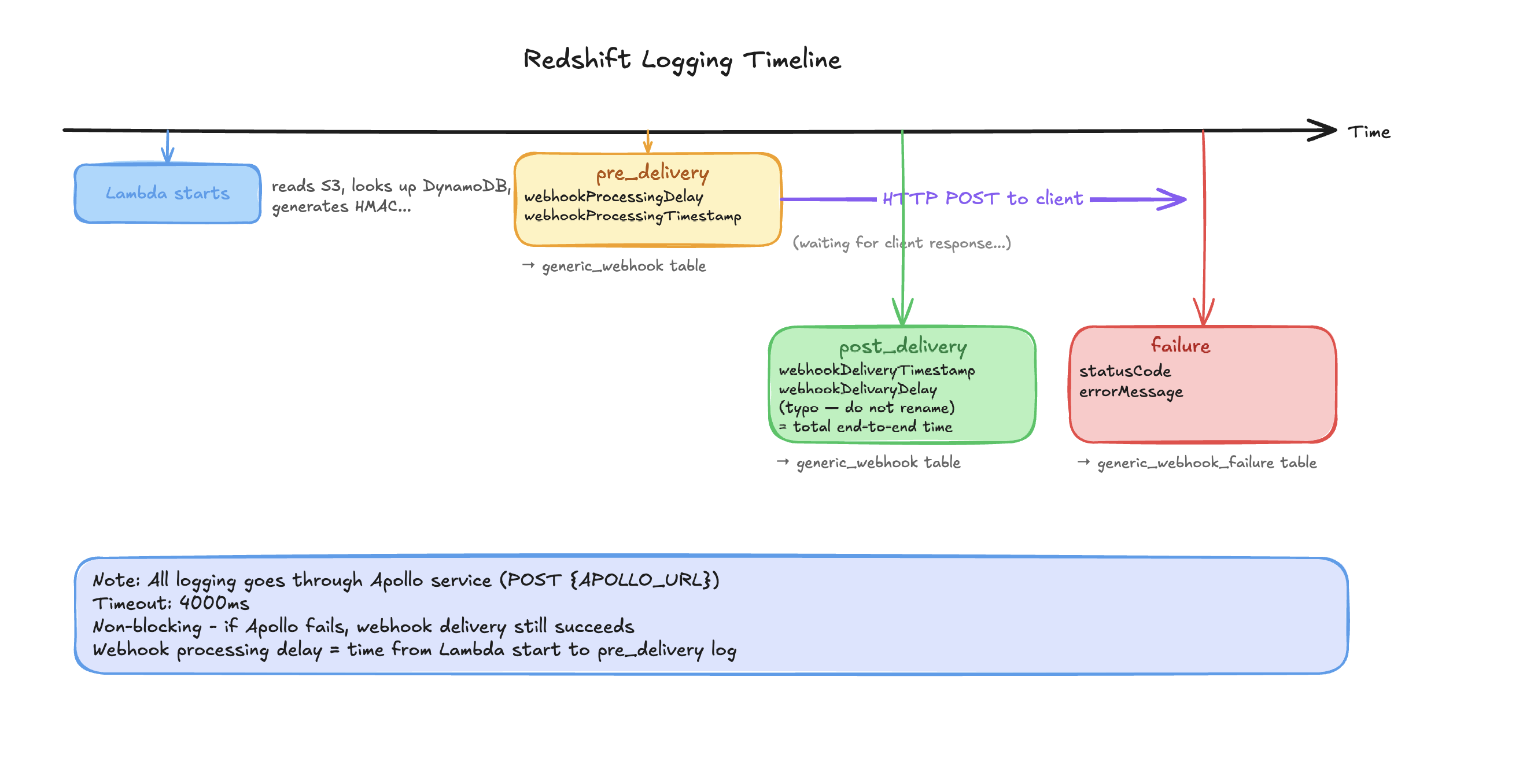
The Delivery Service logs to Redshift by POSTing to the Apollo service:
POST {APOLLO_URL}
Headers:
  appid: {APPID}
  appkey: {APPKEY}
Body:
{
  "project": "{PROJECTNAME or FAILURE_PROJECTNAME}",
  "properties": {
    ...payload,
    "env": "{REDSHIFTENV}"
  }
}
Three log event types:
pre_delivery— Logged before webhook POST. IncludeswebhookProcessingTimestampandwebhookProcessingDelay(time from Lambda start to delivery).post_delivery— Logged after successful POST. IncludeswebhookDeliveryTimestampandwebhookDelivaryDelay(⚠️ typo — do not rename).failure— Logged on delivery error. IncludesstatusCodeanderrorMessage. Written toFAILURE_PROJECTNAMEtable.
Logging is non-blocking. If Apollo fails, delivery still succeeds.
Database migrations
Migration files are in database/migrations/ in the Delivery Service repo. Uses Knex.js with redshift client, port 5439. Migration tracking table: generic_webhook_knex_migrations.
| Migration file | Date | What it does |
|---|---|---|
20240131070646_addGenericWebhookTable.js | 2024-01-31 | Creates generic_webhook table |
20241204022244_addProcessingTimeFields.js | 2024-12-04 | Adds webhook_processing_timestamp and webhook_processing_delay columns |
20241204022715_addGenericWebhookFailureTable.js | 2024-12-04 | Creates generic_webhook_failure table |
cd database
npm install
# Set: DB_HOST, DB_PORT, DB_USER, DB_PASSWORD, DB_NAME
npx knex migrate:latest    # run all pending migrations
npx knex migrate:rollback  # undo the last migration batch
Integrations
Audit Portal (gitlab.com/hvlabs/kyc/audit-portal)
- S3 bucket:
prod-generic-webhook-ind - S3 path:
audit-portal/<appId>/<YYYY-MM-DD>/<eventId>/<eventType>/webhook.json- In
WEBHOOK_ENV=testing:transactionIdreplaceseventIdin path
- In
- Auto-calls Config API: Yes — on every config create/update using
INTERNAL_APPID/INTERNAL_APPKEY - Event types:
FINISH_TRANSACTION_WEBHOOK,INTERMEDIATE_TRANSACTION_WEBHOOK,MANUAL_REVIEW_STATUS_UPDATE,APPLICATION_STATE_RESET - Event gating:
eventsarray in audit-portalconfigstable — only listed event types fire newFlowflag:true(default) = S3 generic webhook flow.false= deprecated direct send. All configs must havenewFlow: true.webhookPayloadBlacklistedKeys: Defaults to["workflowId"]. Keys stripped from payload before S3 upload.additionalMetadataKeys: Set to["workflowId"]to include workflowId in S3 metadata for workflow routing.DISABLE_WEBHOOK_DELIVERY=yes: Disables all delivery in audit-portal without code changes.- SQS consumer: Consumes
dev-audit-portal-finish-transaction.kyc_in_progress→INTERMEDIATE_TRANSACTION_WEBHOOK, any other terminal →FINISH_TRANSACTION_WEBHOOK. - Workflow routing support:
FINISH_TRANSACTION_WEBHOOKandMANUAL_REVIEW_STATUS_UPDATE(generic webhook itself is event-type agnostic)
Link-KYC (gitlab.com/hvlabs/kyc/global-dkyc)
- S3 bucket:
hv-generic-webhook(env:GENERIC_WEBHOOK_S3_BUCKET) - S3 path:
link-kyc/<appId>/<YYYY-MM-DD>/<eventId>/<eventType>/webhook.json - Does NOT call Config API — configs must be registered manually via generic webhook Config API
- Config source: Portal API (
POST {PORTAL_BASE_URL}/api/v2/internal/configs/list), polled every 15 minutes byportalConfigFetcher - Fields from portal:
enableTamperCheck,events,webhookPayloadBlacklistedKeys,additionalMetadataKeys - Defaults if fetch fails:
startTransactionWebhookEnabled: true,webhookPayloadBlacklistedKeys: ['workflowId'],additionalMetadataKeys: [] - Event types:
START_TRANSACTION_WEBHOOK— fires onPOST /v1/link-kyc/start. Gated bystartTransactionWebhookEnabled. RespectswebhookPayloadBlacklistedKeysandadditionalMetadataKeys.EXPIRED_LINK_USED— fires unconditionally whencurrentTime >= expiryTimeinfetchKycAuthDetails(). No config gate.
- No kill switch — no equivalent of
DISABLE_WEBHOOK_DELIVERY
SSL configuration
- All webhook deliveries set
SSL_OP_LEGACY_SERVER_CONNECTon the HTTPS agent (not just bypass list) — supports older servers using legacy SSL renegotiation - A new axios instance is created per
sendWebhookcall — ensures per-appId SSL config isolation APP_IDS_TO_IGNORE_SSL_VERLIFICATION(note typo): for listed appIds,rejectUnauthorized: falseis set — use only for dev/staging
Batch processing
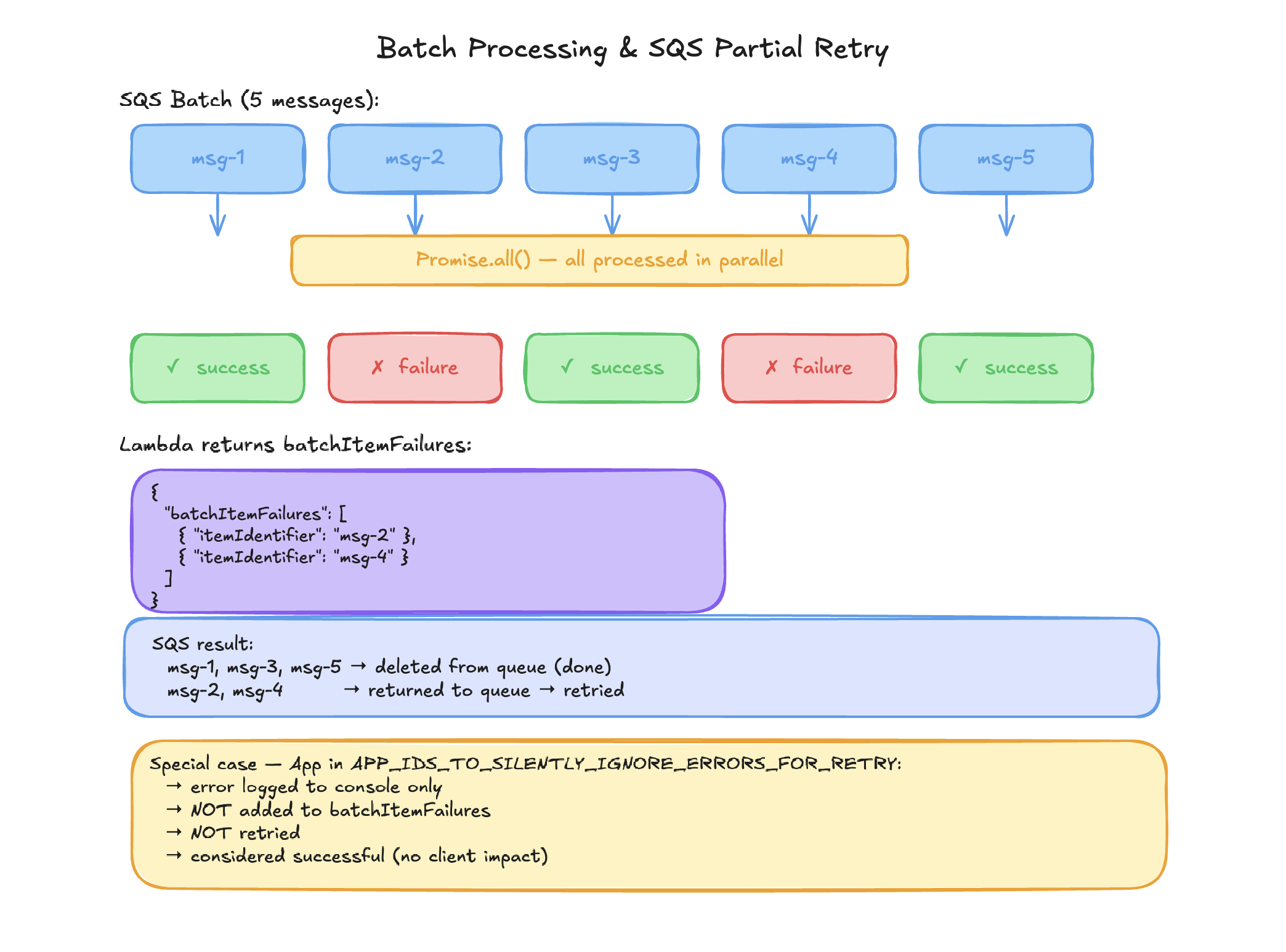
- Lambda receives SQS batch of records
- All records processed in parallel via
Promise.all() - Failed records have
messageIdadded tobatchItemFailures - SQS retries only the failed records (partial batch retry —
ReportBatchItemFailures) - Records for appIds in
APP_IDS_TO_SILENTLY_IGNORE_ERRORS_FOR_RETRYare NOT retried
Installation
Delivery Service:
cd /path/to/global/generic-webhook
npm install
# No local server - Lambda function. Test by invoking handler() with a mock SQS event.
Configuration API:
cd /path/to/ind/generic-webhook
npm install
# Express app wrapped in serverless-http. Run Express app directly for local dev.
Database migrations:
cd database
npm install
# Set: DB_HOST, DB_PORT, DB_USER, DB_PASSWORD, DB_NAME
npx knex migrate:latest
Release process
To be done.
Alert configurations
| Alert | Trigger |
|---|---|
generic-webhook-high-error-rate | CloudWatch alarm on Lambda invocation errors |
generic-webhook-throttles | CloudWatch alarm on Lambda throttling |
Grafana MISCELLANEOUS dashboard | Delivery metrics |
Environment variables
Delivery Service (global/generic-webhook)
| Variable | Description | Example |
|---|---|---|
dynamoTableName | DynamoDB table name for webhook configs | webhook-configs |
APOLLO_URL | Logging endpoint (Apollo service) | https://apollo.example.com/log |
APPID | Apollo authentication appId | webhook-service |
APPKEY | Apollo authentication appKey | secret-key |
PROJECTNAME | Table name for success logs | generic_webhook |
FAILURE_PROJECTNAME | Table name for failure logs | generic_webhook_failure |
REDSHIFTENV | Environment tag for Redshift rows | prod |
AXIOS_TIMEOUT | HTTP request timeout in ms (default: 30000) | 30000 |
APP_IDS_TO_SILENTLY_IGNORE_ERRORS_FOR_RETRY | Comma-separated appIds to skip retry on error | beta-app,test-app |
APP_IDS_TO_IGNORE_SSL_VERLIFICATION | Comma-separated appIds to skip SSL verification (note typo — do not fix) | dev-app-1,staging-app |
Configuration API (ind/generic-webhook)
| Variable | Description | Example |
|---|---|---|
DYNAMODB_TABLE_NAME | DynamoDB table name for webhook configs | webhook-configs |
ALLOWED_IPS | Comma-separated allowed IPs, or * for all | 10.0.0.1,10.0.0.2 or * |
PUBLIC_CERT | RSA public key for JWT (RS256) verification | PEM-encoded public key |
UPDATE_SECRET_DEFAULT_VALUE | Set to yes to auto-generate secret on every new config | yes |
Database migrations (database/)
| Variable | Description | Example |
|---|---|---|
DB_HOST | Redshift cluster endpoint | cluster.abc.region.redshift.amazonaws.com |
DB_PORT | Redshift port (default: 5439) | 5439 |
DB_USER | Redshift username | admin |
DB_PASSWORD | Redshift password | password |
DB_NAME | Redshift database name (default: dev) | dev |